|
Disclosure: This post contains affiliate links and we receive a commission if you visit a link and buy something on our recommendation. Purchasing via an affiliate link doesn’t cost you any extra and the opinions expressed in this post are the author's own. For more details see our disclosure policy and privacy policy.
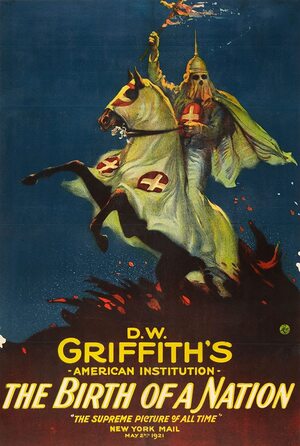
There is no good way to say it really, but this week was a tough one for the challenge. The category this week was a Controversial Film, so it should be something that creates some discussion and hopefully you found something that made you think about the world. If you need to review the list I provided earlier in the week, check out the preview post from this past Sunday.
Now, on to the film I choose this week. The Birth of a Nation is the oldest film I’ve watched so far this year, and if my current plan holds, the oldest film I will watch for the challenge in 2023. It’s the oldest film by far that I’ve watched in some time, excepting some of the very early experimental films made by the Lumiere Brothers and Thomas Edison in the early days of film. But what is The Birth of a Nation and why is it so controversial? 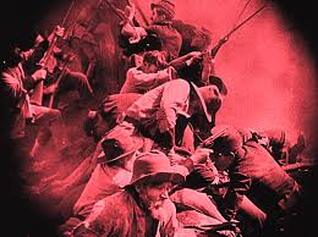 Some of the first grand battle scenes on film. Some of the first grand battle scenes on film.
The film is based on a novel by Thomas Dixon Jr. called The Clansman. You can probably guess at the content based on that title, but I’ll outline it at the high level. The film is split into two parts, the first taking place during the American Civil War. Two families, the abolitionist Stonemans from the North and the “Old South” Camerons, are intertwined in a manner a bit reminiscent of the Capulets and Montagues, with sons from each family falling in love with daughters from the other. Sons from both families are killed in the war and while young Ben Cameron (Henry B. Walthall) leads a charge in his final battle, he is wounded and captured, leading to the announcement that he will be hanged. Elsie Stoneman (Lillian Gish), whom he was in love with, finds him and helps set up a meeting with President Lincoln to ask for a pardon for Ben.
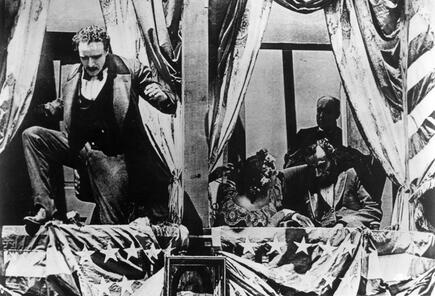 John Wilkes Booth (Raoul Walsh) leaps over the balcony after shooting President Abraham Lincoln (Joseph Henabery) John Wilkes Booth (Raoul Walsh) leaps over the balcony after shooting President Abraham Lincoln (Joseph Henabery)
The film famously depicts the assassination of Abraham Lincoln at Ford’s Theater on April 14, 1865 and feels like a scene placed in the film to add a bit of publicity to the story. It’s certainly not required for the rest of the events of the film, and actually serves as a bit of a distraction from the events before and after. That said, it does close off the first half of the film.
That second half is where the real controversial parts show up. As the story moves to the Reconstruction Era, the Stonemans move to South Carolina to observe the Reconstruction policies being implemented and of course run into the Camerons again. Stoneman bring along his protégé, Silas Lynch, who is described as a mulatto and Lynch is elected lieutenant governor with strong support from the black community. An overwhelmingly black state legislature is depicted with extremely racial stereotypes which I won’t outline here. You might think that is enough to rate as controversy, but you’d be very wrong. 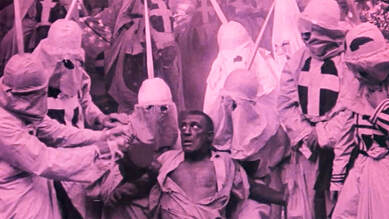 Gus is captured and lynched by the Klansmen. Gus is captured and lynched by the Klansmen.
Ben Cameron comes back into the picture here as he establishes the Ku Klux Klan as a way to fight back against the sudden power the blacks have received in the state. Elsie leaves Ben as a result, and in one of the more famous sequences of the film, Cameron’s little sister Flora (Mae Marsh) goes exploring in the woods only to be accosted by a local freedman named Gus (Walter Long in blackface). She ends up leaping off a ledge to her death and when Ben sees this with Gus fleeing the scene, he rounds up his Klan friends who help him capture and lynch Gus.
This action prompts Lieutenant Governor Lynch to crack down on the Klansmen. The ending of the film devolves into several battles between these various factions, with some combination of the Stonemans and Camerons stuck in the middle. Ultimately Lynch is captured and the Klansmen emerge victorious celebrating through town leading to a new election, now defended by the Klan which will not allow any blacks to vote. 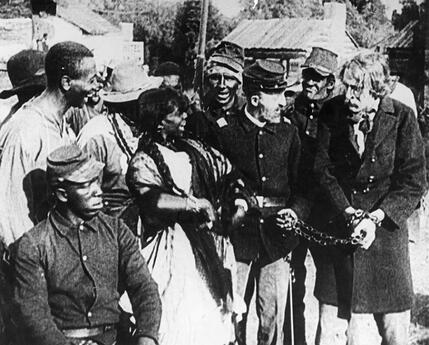 Cameron is captured in response to the lynching of Gus. Cameron is captured in response to the lynching of Gus.
There is a title card right near the end of the film that longs for a time when war will no longer be a scourge on the land, but it can live in peace and harmony, an odd sentiment from a film entirely about the ravages of war, even those that stay behind when the official fighting has stopped.
Now, there is plenty to unpack there and I don’t have time here to fully do so, but if you’re interested, there have been plenty of words already written about this film throughout the last 108 years. What I will say about it is that while I understand its place in cinema history, there is too much going against the film to really recommend it to anyone other than an extremely niche audience of civil war buffs and hardcore cinephiles. So, let’s start with the things this film got right. It is rightly praised for introducing a number of innovations in the use of film technology to tell a story. Keep in mind that when the film was made, motion pictures as an art form had only been around for about 20 years. Yes, there were animated images before 1895, but the first true projected images as we know them today hadn’t been around that long. Director D. W. Griffith used this film to pioneer techniques such as tracking shots, using close-ups and fadeouts, and even the carefully staged battles sequences like we see in war films like Saving Private Ryan, 1917, or the recent All Quiet on the Western Front. There is a tremendous amount of editing throughout with the action cutting between scenes in different locations, often telling multiple stories at the same time. I’m not sure if it was part of the original film, but the version I watched also had different color gradations in the film depending on where a given scene was taking place or who was in the scene. Internal shots were often yellowish with nighttime shots tinted blue or green and battle scenes highlighted by a red tint. 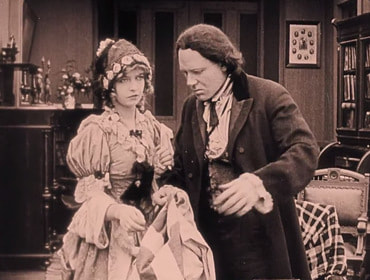 Stoneman discusses things with his daughter. Stoneman discusses things with his daughter.
This is all to say that many of the moviemaking techniques we take for granted today, didn’t exist before Griffith used them in this film. For that, we owe a great deal to this film, despite all its flaws.
Unfortunately, those flaws are many. Some are simply a result of when the film was made while others can only be chalked up to Griffith’s choices and the source material that he used for the film. Chief among these is the general treatment of blacks in the film. While there are some black actors used in certain sequences, the majority of the black characters are portrayed by white actors in blackface. While it might seem shocking to audiences today, this practice was still commonly in use in films through the 1920s and can famously be seen in the first “talkie”, The Jazz Singer, where actor Al Jolson performs on stage in blackface. The use of this practice is especially galling given the fact that some of the background black characters are black actors, but the one that feature in the plot are all white actors in blackface. Even the mixed-race Lynch is clearly a white actor with almost no effort to make him look otherwise. Beyond the blackface element, there is of course the inclusion of Ku Klux Klan which led to an increase in Klan activity following the release of the film. According to my brief research on this, the Klan was largely defunct by 1872 and as such lay dormant until The Birth of a Nation burst on the scene. The fact that this film is largely credited with the rebirth of the Klan, serves as multiple demerits against it. The two items discussed above are reason enough to downgrade this film, even in light of the technical advances it made, but if we go back to those advances, even some things there detracted from the overall film. First, looking back at the editing techniques that were pioneered, including cross-cutting between multiple locations to tell several storylines at once. While it was revolutionary at the time, I honestly don’t think it was executed particularly well. Perhaps that is due to the fact that it was the first time anyone was trying this approach, but it often feels like Griffith had this brilliant new idea of how to tell a story and ended up overusing it in this film. Another major negative point for the film is the overall length. At well over three hours, this is a lot of film to sit through and I can’t help thinking that 90% of the sequences could be half as long as they are. The battle scenes are impressive for the time in which they were created, but they drag on. The famous scene of Gus chasing Flora through the woods lasts well over 20 minutes, something that could have been covered in half that time with more intentional shot selection. The last major mark against the film, for me at least, is the cast of characters. Not the acting itself mind you. While it is overacted throughout, that is the fault of it being a silent film, not of the actors themselves. What I’m talking about is the sheer size of the cast in terms of who we need to pay attention to. Even with the list of cast members right at the beginning of the film, there is easily two pages of characters, none of which we’ve met at that point. The two families are so similar in their makeup, that it’s hard to tell them apart. Combine that with the fact that we can only see them visually and never hear their voices, the Stonemans and Camerons blend into one giant mass of a family. Again, this may be intentional, but it made my viewing confusing. I’ve gone on longer about this film than any other I’ve watched for this challenge, but given how long it is and the long history the film has, I thought it worthwhile. As I mentioned above, I can’t really recommend this film to anyone outside a few select groups, but if you are someone interested in the early history of cinema, consider watching select parts of this film. The entire 193 minutes is not for everyone, but you can learn quite a bit about early film techniques from The Birth of a Nation.
0 Comments
Leave a Reply. |
AuthorI'm just a film buff who wants to watch great movies. Where else to find the best, than the list of those nominated by the Academy each year? Archives
May 2023
Categories
All
|
 RSS Feed